
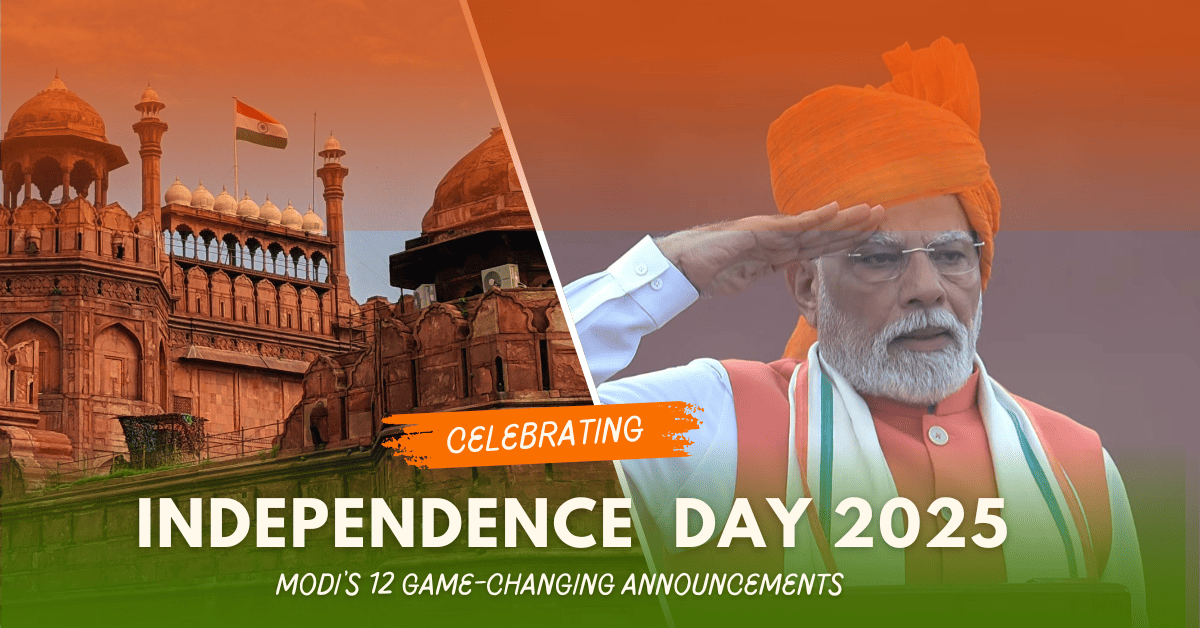
The Modi Independence Day Speech 2025, delivered on August 15 from the Red Fort, set the nation abuzz, marking Prime Minister Narendra Modi’s 12th consecutive address on India’s 79th Independence Day. Lasting a record 103 minutes, this landmark speech outlined an ambitious roadmap across employment, economic reforms, defence modernisation, technological self-reliance, energy expansion, social security, resource management, and agricultural innovation. In this deep dive into the Modi Independence Day Speech 2025, we unpack the 12 game-changing announcements that promise to reshape India’s destiny as it approaches its centenary in 2047.
Throughout this comprehensive analysis of the Modi Independence Day Speech 2025, you will find in-depth insights into each initiative—its objectives, implementation framework, projected impact, and how it aligns with India’s broader vision of a developed nation. We also demonstrate how these measures interlock to create a synergistic transformation across sectors.
1.₹1 Lakh Crore Employment Masterplan

The centrepiece of the Modi Independence Day Speech 2025 was the unveiling of the Pradhan Mantri Viksit Bharat Rozgar Yojana, a historic ₹1 lakh crore scheme designed to generate 3.5 crore new jobs over the next two years. Addressing the twin challenges of youth unemployment and skill development, this program combines direct financial support for employees and hiring incentives for employers:
-
Employee Incentives: First-time job seekers earning up to ₹1 lakh monthly will receive a total of ₹15,000 from the government, disbursed in two equal instalments of ₹7,500. The first tranche is paid after six months of continuous employment, while the second follows after twelve months, contingent upon completion of a financial literacy course. This structured approach not only eases the initial financial transition for new workers but also fosters long-term financial planning skills.
-
Employer Subsidies: Manufacturing sector employers hiring new workers under this scheme will receive ₹3,000 per employee per month for up to two years. These funds aim to reduce hiring costs, incentivise scaling of operations, and spur private sector growth.
-
Implementation Timeline: Effective from August 1, 2025, through July 31, 2027, the program will be administered via an integrated digital platform to ensure transparency, real-time tracking of enrollments, and seamless fund transfers.
By embedding financial literacy into the employment journey and distributing incentives across both demand (employers) and supply (employees) sides, the scheme addresses systemic unemployment and builds a foundation for India’s manufacturing and services sectors to flourish.
2. Next-Generation GST Reforms: A Diwali Gift
In a strategic move timed as a “Diwali gift,” the Modi Independence Day Speech 2025 announced sweeping Goods and Services Tax (GST) reforms to be rolled out by the upcoming festival season. These next-generation reforms simplify India’s complex tax structure and deliver tangible savings to consumers:
-
Two-Tier Slab Structure: The existing four-slab system (5%, 12%, 18%, 28%) will be replaced by two slabs: 5% and 18%. Essential items will be taxed at 5%, bringing relief to 99% of goods previously in the 12% bracket. Most items formerly taxed at 28% shift to 18%, easing the burden on middle-income consumers.
-
Luxury Tax Bracket: A new 40% slab targets high-end luxury goods, ensuring that premium consumption contributes a fair share to the exchequer while protecting revenue integrity.
-
Revenue Neutrality: Detailed modelling indicates these adjustments remain revenue-neutral, balancing broader base coverage with higher rates on discretionary purchases.
-
Stimulating Demand: Lower tax rates on everyday items, coupled with festival-season marketing, are expected to boost consumer spending by up to 7% in Q4 of FY 2025-26.
This bold overhaul streamlines compliance for businesses and enhances ease of doing business, while stimulating domestic consumption—key to reviving post-pandemic growth and sustaining expansion into the next decade.
3. Mission Sudarshan Chakra: Indigenous Air Defence Revolution

Security concerns in South Asia inspired one of the most consequential announcements of the Modi Independence Day Speech 2025: Mission Sudarshan Chakra. Drawing symbolic power from the mythological weapon, this multi-layered defence shield is India’s homegrown counter to aerial threats:
-
Layered Defence Architecture: The system integrates long-range radars, satellite surveillance, infrared sensors, interceptor missiles, and directed-energy components into a cohesive network designed to neutralise aircraft, drones, and ballistic missiles.
-
Civil-Military Protection: Beyond military installations, Sudarshan Chakra will safeguard critical civilian infrastructure, including hospitals, transportation hubs, power plants, and places of worship.
-
Domestic R&D Emphasis: Developed jointly by DRDO, ISRO spin-offs, private startups, and academic institutions, the program will follow a mission-mode template with dedicated war rooms, cutting-edge labs, and industry alliances.
-
Timeline and Budget: Over ₹50,000 crore is earmarked across ten years, aiming for phased deployment from 2028 and full operational capability by 2035.
By anchoring advanced air defence technology in domestic ecosystems, India enhances strategic autonomy and nurtures high-end engineering skills, aligning with Atmanirbhar Bharat and Make in India objectives.
4. Operation Sindoor: A Paradigm Shift in Counter-Terrorism
A detailed highlight of the Modi Independence Day Speech 2025 was Operation Sindoor, a series of precision strikes against nine terrorist camps in Pakistan and Pakistan-occupied Kashmir:
-
Neutralisation Figures: Over 100 terrorists eliminated, dozens of high-value targets destroyed, and safe civilian crossings ensured.
-
Equipment Showcase: Operation Sindoor underscored the efficacy of indigenous hardware—Tejas jets, Pinaka rockets, and surveillance drones—all developed or assembled domestically.
-
Strategic Messaging: By publicising cross-border operations, Modi signalled India’s readiness to adopt pre-emptive counter-terrorism measures, influencing regional deterrence calculus.
-
Interagency Coordination: Intelligence bureaus, the military, and specialised counter-terrorism units collaborated in a textbook example of joint operations, setting new standards for rapid decision-making.
Operation Sindoor represents a shift from reactive defence to proactive deterrence, strengthening national security doctrine and reinforcing India’s stance against cross-border terrorism.
5. Semiconductor Self-Reliance: India’s Chip Revolution

Breaking a five-decade technological gap, the Modi Independence Day Speech 2025 heralded India’s entry into semiconductor manufacturing:
-
First Made-in-India Chip: A consumer microprocessor built entirely on Indian soil will reach markets by December 2025. This achievement follows years of development in university labs, defence R&D units, and public-private consortia.
-
Facility Network: Six existing fabs are now operational, while four more projects with a combined ₹4,594 crore outlay have been approved, totalling ten facilities across six states.
-
Workforce Development: A semiconductor talent pipeline is being nurtured through dedicated courses at IITs, industry-run training centres, and apprenticeship programs, addressing the global chip shortage and India’s technological aspirations.
-
Global Supply Chains: By 2027, India expects to export semiconductors worth $2 billion annually, tapping into electronics, automotive, telecom, and defence markets.
This semiconductor push delivers not only strategic autonomy in critical electronics but also high-value manufacturing jobs and innovation spillovers for emerging sectors like AI, IoT, and 5G.
6. Indigenous Jet Engine Challenge: Ultimate Tech Aspiration

In a stirring appeal during the Modi Independence Day Speech 2025, Modi challenged Indian engineers and researchers to master jet engine technology:
-
Aerospace Ambition: Only a handful of nations produce high-performance jet turbines; India’s entry into this elite club would secure self-sufficiency in fighter jet production.
-
Collaborative Ecosystem: DRDO, HAL, private aerospace firms, and academic institutions will collaborate on prototype development, materials science, and digital twins to simulate engine performance.
-
Funding and Incentives: A ₹10,000 crore Jet Engine Development Fund will underwrite projects over the next decade, complemented by fast-track clearances, tax breaks, and royalty-free patents for research breakthroughs.
-
Broader Impact: Technologies developed—advanced alloys, precision machining, thermal coatings—will benefit power generation, automotive turbochargers, and industrial gas turbines.
This directive signals India’s ambition to conquer one of the most complex engineering frontiers, boosting aerospace exports and strategic autonomy.
7. Nuclear Energy Expansion: Clean Power for the Future

Addressing energy security and climate goals, the Modi Independence Day Speech 2025 laid out an ambitious nuclear power roadmap:
-
Ten New Reactors: Work has commenced on ten cutting-edge reactors, including small modular reactor (SMR) prototypes and advanced heavy water reactors.
-
Tenfold Capacity Target: From the current 8.8 GW baseline, nuclear capacity will surge to 88 GW by 2047, contributing roughly 15% of India’s electricity mix.
-
Private Sector Entry: For the first time, private companies can own and operate nuclear plants under stringent regulatory oversight, promoting competition, innovation, and efficiency.
-
R&D Focus: Investments in thorium reactor research, waste-minimisation technologies, and modular construction methods will drive global leadership in next-generation nuclear power.
This bold expansion secures baseload clean energy, reduces carbon footprint, and supports India’s net-zero ambitions while diversifying the energy portfolio beyond renewables and fossil fuels.
8. Samudra Manthan Deep-Water Exploration Mission

The Modi Independence Day Speech 2025 announced the National Deep-Water Exploration Mission, codenamed “Samudra Manthan,” targeting offshore oil and gas resources:
-
Andaman Sea Priority: Geological surveys indicate significant hydrocarbon reserves in deepwater blocks—drilling is scheduled for 2026 with advanced rigs and subsea technology.
-
Mission-Mode Approach: Centralised project management, multi-agency coordination, and dedicated R&D centres mirror the success of Chandrayaan and Mangalyaan missions.
-
Blue Economy Integration: Beyond hydrocarbons, the mission will assess seabed minerals—polymetallic nodules, cobalt crusts—and study marine biodiversity for sustainable harvesting.
-
Energy Security: Deepwater production, combined with renewable offshore wind parks, aims to cut import dependence by 20% by 2035.
This mission enhances strategic maritime capability, fosters specialised engineering skills, and propels India to the forefront of ocean resource development.
9. High-Powered Demography Mission: Securing Borders and Identity

In a decisive move, the Modi Independence Day Speech 2025 launched a Demography Mission to safeguard national identity and border community rights:
-
Illegal Immigration Countermeasures: Enhanced surveillance, biometric databases, and rapid response teams will curtail infiltration along sensitive frontiers.
-
Tribal Land Protection: Special cells will address land encroachment in northeastern states, ensuring legal redress and community empowerment.
-
Socio-Economic Integration: Skill development, micro-credit, and livelihood programs aim to uplift border populations, reducing vulnerability to external influences.
-
Public Awareness Campaign: National education drives will highlight the importance of demographic security and cultural heritage preservation.
This initiative frames demographic changes as integral to national security policy, balancing humanitarian concerns with sovereign rights.
10. National Critical Mineral Mission

Resource security received a major boost as the Modi Independence Day Speech 2025 unveiled the National Critical Mineral Mission:
-
Exploration Portfolio: Over 1,200 prospective sites mapped for lithium, cobalt, rare earths, and other strategic minerals vital for batteries, electronics, and clean energy.
-
Block Auctions: Twenty-four blocks have been auctioned, with plans for 100 more by 2030—attracting global mining firms and domestic consortia.
-
Value-Chain Development: Downstream processing hubs will convert raw ores into refined products, fostering domestic manufacturing of batteries, magnets, and catalysts.
-
International Partnerships: Bilateral agreements with resource-rich nations ensure diversified supply and technology transfers.
Securing critical minerals underpins India’s ambitions in EVs, renewable energy, aerospace, and defence industries, mitigating geopolitical risks in raw material procurement.
11. Indus Water Treaty Reassessment: Defending Farmer Rights

Water diplomacy took centre stage when the Modi Independence Day Speech 2025 challenged the longstanding Indus Water Treaty:
-
“Blood and Water Cannot Flow Together”: Modi’s assertive stance signals willingness to renegotiate terms that he labelled “one-sided,” prioritising Indian irrigation needs.
-
Farmer-Centric Policies: Enhanced storage infrastructure, canal modernisation, and river-linking projects will mitigate potential shortfalls, ensuring agricultural stability.
-
Diplomatic Engagement: While standing firm on national interests, India proposes a joint technical committee to explore equitable water-sharing frameworks.
-
Climate Resilience: Integrated watershed management and advanced forecasting systems will optimise water use efficiency amid changing monsoon patterns.
This assertive approach to transboundary water management elevates India’s negotiating position while safeguarding agricultural livelihoods.
12. Agricultural Modernisation: Precision, Sustainability, and Prosperity

Concluding the Modi Independence Day Speech 2025, Modi emphasised agriculture as the backbone of Indian prosperity:
-
Precision Farming: Satellite imagery, drone-based soil health analysis, and AI-driven crop monitoring will boost yields by 20% while conserving inputs.
-
Climate-Resilient Seeds: Development and distribution of drought-tolerant, flood-resistant, and high-nutrition seed varieties will safeguard food security.
-
Digital Market Linkages: Expansion of e-NAM, direct-to-consumer e-commerce platforms, and refrigerated logistics corridors will reduce post-harvest losses by 30%.
-
Sustainable Practices: Incentives for organic farming, micro-irrigation, and solar-powered cold storage align productivity with environmental stewardship.
By marrying technology with grassroots reforms, this agricultural agenda aims to double farmer incomes by 2030 and position Indian agriculture as a global model.
In summary, the Modi Independence Day Speech 2025 articulated a visionary blueprint for India’s next phase of development. From creating 3.5 crore jobs to overhauling the GST regime; from indigenous defence shields to semiconductor self-reliance, from deepwater drilling to nuclear expansion; and from demographic security to critical mineral exploration—each announcement interlocks to propel India towards its centenary in 2047 as a prosperous, secure, and technologically advanced nation. This holistic roadmap demands sustained execution, private sector collaboration, and societal buy-in across all strata, ensuring that the transformational promises of the Modi Independence Day Speech 2025 translate into lived realities for every Indian citizen.