
📢 Introduction: The Shock That Shook Global Trade
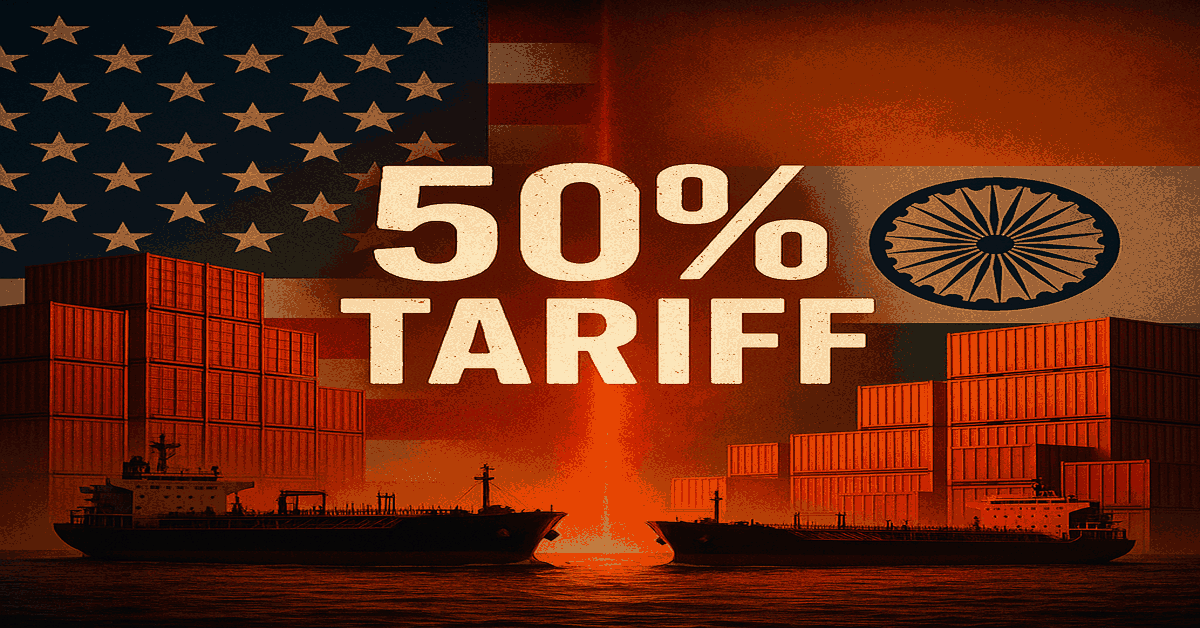
In August 2025, Donald Trump’s 50% Tariff on India sent shockwaves through global trade. The White House announcement doubled duties on more than half of India’s exports to the United States, increasing many tariff lines from 25% to 50%. It was presented as a direct response to India’s decision to continue buying deeply discounted Russian crude oil despite Western sanctions.
The announcement came without much warning, giving businesses just weeks to react. Exporters from Jaipur’s textile district to Pune’s auto parts hubs were left scrambling to salvage contracts. For the Indian economy — which had enjoyed consistent GDP growth, low energy costs, and a stable export portfolio over the previous three years — this was more than a policy change. It was a test of resilience, adaptability, and foreign policy strategy.
From Washington’s perspective, this tariff was not only an economic weapon but also a geopolitical message: market access comes with compliance to global sanction priorities. For New Delhi, it was a moment to assert the country’s strategic autonomy, reinforce energy security, and explore diversified markets.
In this in‑depth analysis, we’ll examine why Donald Trump’s 50% Tariff on India happened, which industries and communities were most affected, the retaliatory and protective measures India has implemented, the diplomatic backdrop including high‑profile visits, and the possible resolution scenarios that could define the next decade of India–US relations.
🛢️ Why Donald Trump’s 50% Tariff on India Happened
After Russia invaded Ukraine in February 2022, the United States, the European Union, and allies imposed some of the most sweeping sanctions in modern history. The sanctions targeted key sectors, especially oil and gas, in an effort to cut off Russia’s main revenue streams and weaken its war effort.
India’s Strategic Energy Calculus
Unlike most Western partners, India saw opportunity in the oil markets. Facing global crude prices above $100 per barrel, it negotiated 20–30% discounts on Russian crude, which:
-
Reduced import bills dramatically
-
Helped keep petrol and diesel prices stable domestically
-
Contained inflation below 5% during volatile global conditions
Russian oil’s share in India’s import basket:
-
Pre‑2022: < 2%
-
Mid‑2023: ~28%
-
Mid‑2025: ~35%
From India’s standpoint, this was smart economics — buying affordable energy ensured stability for over 1.4 billion people and sustained post‑pandemic recovery.
From Washington’s lens, however, India was providing Moscow with a critical revenue lifeline, undermining the sanctions coalition.
🎯 Key Industries Affected by Donald Trump’s 50% Tariff on India
The tariff targeted over 1,200 HS codes — equivalent to more than half of India’s annual US-bound export value.
1. Textiles & Garments
-
Share in US exports: ~25%
-
Impact: 70–80% order cancellations reported within weeks in hubs like Tiruppur, Surat, and Jaipur.
-
Worker effect: Millions in the textile value chain faced reduced hours or layoffs.
2. Gems & Jewellery
-
Primary hub: Surat — polishes ~90% of the world’s diamonds.
-
Impact: 40% drop in US orders.
-
Knock-on effects: Small polishing units dependent on US buyers were compelled to downsize.
3. Leather & Footwear
-
Centre: Chennai, Agra
-
Impact: 60% decline in American orders for leather handbags, premium shoe uppers, and automotive leather upholstery.
4. Chemicals & Specialty Materials
-
Products: Dyes, pigments, industrial chemicals.
-
Impact: Exports plunged as US partners shifted to suppliers in Europe/SEA — however, quality mismatches slowed transitions.
5. Automobile Components
-
Impact: Pune and Manesar plants supplying US OEMs faced 12–16 week production gaps after contract terminations.
6. Agricultural Products
-
Products: Basmati rice, black pepper, tea, shrimp.
-
Impact: US imports from India dropped; Brazil, Thailand, and Vietnam filled the gap.
✅ Sectors Exempt from the Tariff
Certain categories avoided the 50% duty — mostly due to mutual dependency:
-
Pharmaceuticals: India is the largest supplier of generics to the US; any disruption would raise healthcare costs.
-
Electronics: Smartphones, semiconductors; supports India’s growing role in global tech supply chains.
-
Energy Equipment: Solar panels, turbines — aligns with clean energy goals.
-
Critical Minerals: Lithium, cobalt, and rare earths are needed for EV and defence sectors.
👷♂️ Human Stories Behind the Numbers
Trade data tells only part of the story. The real impact is visible in how families, small businesses, and communities are coping.
Jaipur Weaver – Arjun Singh
“I’ve been working my father’s loom for 20 years. Our American buyer canceled his usual 10,000 meters order for handloom cotton. We’ve had to cut worker shifts by half.”
Punjab Basmati Farmer – Jaswinder Kaur
“We perfected this rice for US markets. Now buyers have switched to Thailand and Pakistan. Selling locally means slashing prices by 20%.”
Hyderabad Pharma Engineer – Dr. Meera Rao
“Even with exemptions, our logistics depend on components from sectors that are tariff-hit. Delays at one end ripple through drug production.”
Pune Auto Parts Maker – Suresh Patel
“Losing a US contract means finding a new buyer, but automotive components need months for testing and certification.”
💸 How the Tariff Hit the US Consumer Too
-
Clothing Inflation: US clothing CPI rose 2.1% MoM in September 2025 — the sharpest in over a decade.
-
Generic Drug Prices: Even exempt categories saw an indirect cost bump of 5–7% due to logistic bottlenecks.
-
Supply Chain Delays: Lead times tripled for certain inputs, affecting production runs, car repairs, and even consumer electronics launches.
🌍 Diplomatic Moves Amid Donald Trump’s 50% Tariff on India
High-profile leader visits amplified the strategic backdrop.
June 2025 – Ajit Doval in Moscow
-
Signed fresh oil supply contracts with extended discounts
-
Enhanced defence cooperation: joint training and equipment co‑production
-
Signalled defiance to align oil policy with US wishes
July 2025 – Vladimir Putin in Delhi
-
Expanded LNG and crude supply deals
-
Defence, space, and infrastructure cooperation agreements worth billions
-
Political messaging: Russia remains a major strategic partner
August 2025 – Narendra Modi in Beijing
-
Signed trade-expansion MoUs under the RCEP
-
Currency swap lines to boost INR–Yuan trade
-
Joint infrastructure financing projects in South Asia
These moves projected India’s multi-vector foreign policy, showing the ability to pivot diplomatically and economically.
⚙️ India’s Strategic Response to Donald Trump’s 50% Tariff on India
-
Energy Diversification:
-
Contracts with Saudi Arabia & Iraq increased by 25%
-
LNG terminals boosted to import from the US, Qatar, and Mozambique
-
-
Renewable Energy Push:
-
20 GW solar auctioned and 5 GW offshore wind approved
-
Green Hydrogen Mission got ₹75,000 crore in new funding
-
-
Export Relief:
-
RoDTEP rebates increased for textiles, leather, seafood
-
₹50,000 crore credit facility for MSME exporters
-
-
Defence–Trade Linkage:
-
Paused $5 billion US defence procurements (aircraft, helicopters)
-
-
WTO‑Compliant Retaliatory Tariffs:
-
Drafted measures on US almonds, cotton, and apples to signal readiness
-
🔧 Survival Playbook for Indian Exporters
-
Rebalance SKUs: Focus on exempt lines like high-end electronics accessories or certain pharma excipients.
-
Value Addition: Target designer and premium niche to sustain margins.
-
Near-Market Assembly: Ship semi-knocked-down kits to the UAE/Singapore and finish assembly for re‑export to the US.
-
Smart Contracts: Include tariff-sharing & renegotiation clauses.
-
Diversify Markets: Grow share in ASEAN, MENA, and EU via trade fairs and digital exports.
🛒 How US Buyers Are Adapting
-
Dual-Sourcing: Keeping part orders in India to maintain supply chain familiarity, balancing with Vietnam, Bangladesh.
-
Vertical Integration: Firms investing in upstream operations in India for partial tariff avoidance.
-
Advocacy: Coalition‑building with US retailers to seek selective exemptions.
🔮 Four Possible Future Scenarios
-
Negotiated Rollback: India agrees to reduce Russian oil imports and increase transparency; phased tariff removal in 6–12 months.
-
Comprehensive FTA: Expands scope to include services, IP, and digital trade — normalising tariff schedules.
-
Asian Pivot: Permanent shift of India’s export focus to ASEAN, GCC, EU.
-
Green Partnership: Renewable energy cooperation becomes the keystone of post‑tariff reconciliation.
📊 Quick FAQ
Q: Why did Donald Trump’s 50% Tariff on India happen?
A: To pressure India over its discounted Russian oil imports, seen as breaching sanctions unity.
Q: Which exports faced the heaviest blow?
A: Textiles, gems, leather, chemicals, auto parts, seafood, and agricultural products.
Q: Which sectors are safe from the tariff?
A: Pharmaceuticals, electronics, critical minerals, energy equipment.
Q: How dependent is India on Russian oil?
A: ~35% of imports as of mid‑2025.
Q: Is repeal likely?
A: Only via diplomatic trade‑offs linking energy sourcing commitments to tariff relief.
🏁 Conclusion
Donald Trump’s 50% Tariff on India is more than a trade penalty — it’s a case study in the overlap between geopolitics, energy policy, and economics in the 21st century. For Indian exporters, adaptation means innovation in markets, supply chains, and value propositions. For US buyers, it’s a lesson in supply chain resilience versus cost efficiency. And for both governments, it’s a reminder that in a multipolar world, economic tools are as much about diplomacy as dollars.